New research from Lawrence Livermore National Laboratory (LLNL), Calif., aims to tackle the problem of corrosion, which costs trillions of dollars globally. Their solution is to predict failure and design better materials up front.
“Our current knowledge of corrosion is based on historical data from well-known and well-characterized metal compositions and processing,” said LLNL scientist and author Brandon Wood. “As soon as you alter the composition at all or alter the way the materials are processed, all bets are off.”
Using a novel technique that employs advanced kinetic modeling, the team simulated corrosion processes with both speed and accuracy and identified the effects of operating conditions and material composition.
The researchers focused their simulation efforts on the natural protective oxide film that forms on metals. This film is crucial for keeping the metal intact. If it dissolves or fractures, or if it becomes permeable to attack, corrosion creeps in.
“Putting certain metals close to one another creates a sort of microbattery that can drive corrosion,” Wood said. “This has been a problem in building ships and bridges, for instance. Our model can in principle account for such effects, while also being flexible enough to consider the interplay between the corrosive environment and the base metal composition.”
That’s just one example of a scenario where this model might be helpful. By advancing our understanding of corrosion and developing predictive tools, this research paves the way for designing materials that can withstand the test of time.
The LLNL team’s findings are published in the journal Nature Communications.
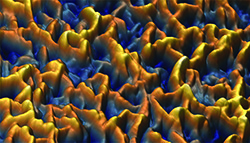
Image – Image of porous nickel oxide formed during the dissolution-reprecipitation process. Image was captured using atomic force microscopy. Courtesy of Lawrence Livermore National Laboratory.
************
For more information:
Lawrence Livermore National Laboratory