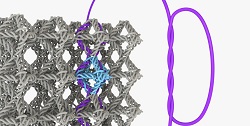
In the latest advance in nano- and micro-architected materials, engineers at Caltech, Pasadena, Calif., developed a new material made from numerous interconnected microscale knots.
The knots make the material far tougher than identically structured but unknotted materials.
They absorb more energy and are able to deform more while still being able to return to their original shape undamaged. These new knotted materials may find applications in biomedicine as well as in aerospace applications due to their durability, possible biocompatibility, and extreme deformability.
“The capability to overcome the general trade-off between material deformability and tensile toughness [the ability to be stretched without breaking] offers new ways to design devices that are extremely flexible, durable, and can operate in extreme conditions,” says former Caltech graduate student Widianto P. Moestopo, lead author of a paper on the nanoscale knots that was published in Science Advances.
Each knot is around 70 micrometers in height and width, and each fiber has a radius of around 1.7 micrometers (around one-hundredth the radius of a human hair). While these are not the smallest knots ever made—in 2017 chemists tied a knot made from an individual strand of atoms—this does represent the first time that a material composed of numerous knots at this scale has ever been created. Further, it demonstrates the potential value of including these nanoscale knots in a material—for example, for suturing or tethering in biomedicine.
The knotted materials, which were created out of polymers, exhibit a tensile toughness that far surpasses materials that are unknotted but otherwise structurally identical, including ones where individual strands are interwoven instead of knotted. When compared to their unknotted counterparts, the knotted materials absorb 92 percent more energy and require more than twice the amount of strain to snap when pulled.
The knots were not tied but rather manufactured in a knotted state by using advanced high-resolution 3D lithography capable of producing structures in the nanoscale. The samples detailed in the research paper contain simple knots—an overhand knot with an extra twist that provides additional friction to absorb additional energy while the material is stretched. In the future, the team plans to explore materials constructed from more complex knots.
For more information:
Caltech