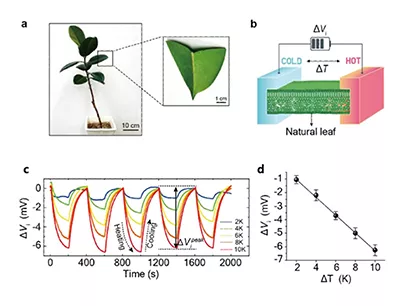
Professor Yoon Hyo-jae’s research team at Korea University has discovered that rubber plant leaves can naturally generate electricity through a phenomenon called the ionic Seebeck effect, without any additional processing. This effect occurs when moisture and ions within the plant tissues move in response to temperature differences, creating voltage. Notably, partially drying the leaves forms a conductive surface layer that significantly enhances this energy conversion. This breakthrough reveals that plants, traditionally known for photosynthesis and gas exchange, can also function as high-performance thermoelectric devices, outperforming many artificial materials.
The researchers confirmed that the ionic Seebeck effect is exhibited not only in dried leaves but also in living leaves, enabling electricity generation. They also discovered that when electrodes were attached to living leaves and exposed to light, a stable voltage was repeatedly generated and that this energy conversion process did not affect the leaf’s physiological functions.
Kang Hun-gu, the first author of the article, said, “The fact that leaves can serve as ‘living thermoelectric devices’ that generate electricity by receiving heat is a new plant function that has not been observed until now. Our study well demonstrates a convergence research paradigm that interconnects chemistry, biology, and energy science.”
This research holds significant value from a sustainability point of view because the results could enable the utilization of plants in their natural state. Furthermore, since changes in plant health can be detected in real time, the results of this study are expected to have wide applications in environmental and agricultural fields, such as climate change response and plant growth monitoring.
This study was supported by the National Research Foundation of Korea.
For more information: Korea University
Image: △ (a), (b) Photographs of a Ficus elastica leaf used in the experiments, and a conceptual diagram of a device for measuring thermopower performance.
(c), (d) Results of measuring the thermovoltage observed from the Ficus elastica leaf.