Researchers at the Massachusetts Institute of Technology have built an AI model capable of classifying and quantifying certain defects using data from a noninvasive neutron-scattering technique. The model, which was trained on 2,000 different semiconductor materials, can detect up to six kinds of point defects in a material simultaneously, something that would be impossible using conventional techniques alone.
“Existing techniques can’t accurately characterize defects in a universal and quantitative way without destroying the material,” says lead author Mouyang Cheng, a PhD candidate in the Department of Materials Science and Engineering. “For conventional techniques without machine learning, detecting six different defects is unthinkable. It’s something you can’t do any other way.”
The researchers say the model is a step toward harnessing defects more precisely in products like semiconductors, microelectronics, solar cells, and battery materials. Their paper appears in the journal Matter.
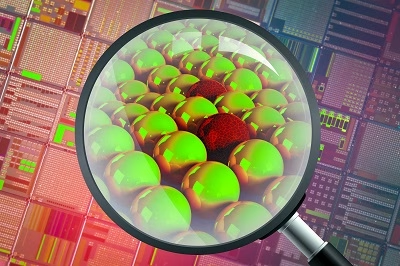
“Right now, detecting defects is like the saying about seeing an elephant: Each technique can only see part of it,” says senior author and associate professor of nuclear science and engineering Mingda Li. “Some see the nose, others the trunk or ears. But it is extremely hard to see the full elephant. We need better ways of getting the full picture of defects, because we have to understand them to make materials more useful.”
There are often multiple defects in each material. Unfortunately, each method for understanding defects has its limits. Techniques like X-ray diffraction and positron annihilation characterize only some types of defects. Raman spectroscopy can discern the type of defect but can’t directly infer the concentration. Transmission electron microscopy requires people to cut thin slices of samples for scanning.
For their experiment, the researchers built a computational database of 2,000 semiconductor materials. They made sample pairs of each material, with one doped for defects and one left without defects, then used a neutron-scattering technique that measures the different vibrational frequencies of atoms in solid materials. They trained a machine-learning model on the results.
“That built a foundational model that covers 56 elements in the periodic table,” Cheng says. “The model leverages the multihead attention mechanism, just like what ChatGPT is using. It similarly extracts the difference in the data between materials with and without defects and outputs a prediction of what dopants were used and in what concentrations.”
The researchers fine-tuned their model, verified it on experimental data, and showed it could measure defect concentrations in an alloy commonly used in electronics and in a separate superconductor material.
The researchers also doped the materials multiple times to introduce multiple point defects and test the limits of the model, ultimately finding it can make predictions about up to six defects in materials simultaneously, with defect concentrations as low as 0.2 percent.
“We were really surprised it worked that well,” Cheng says. “It’s very challenging to decode the mixed signals from two different types of defects, let alone six.”
The results were exciting for the researchers, but they note their technique measuring the vibrational frequencies with neutrons would be difficult for companies to quickly deploy in their own quality-control processes.
“This method is very powerful, but its availability is limited,” Rha says. “Vibrational spectra is a simple idea, but in certain setups it’s very complicated. There are some simpler experimental setups based on other approaches, like Raman spectroscopy, that could be more quickly adopted.”
Li says companies have already expressed interest in the approach and asked when it will work with Raman spectroscopy, a widely used technique that measures the scattering of light. Li says the researchers’ next step is training a similar model based on Raman spectroscopy data. They also plan to expand their approach to detect features that are larger than point defects, like grains and dislocations.
For now, the researchers believe their study demonstrates the inherent advantage of AI techniques for interpreting defect data.
For more information:
Massachusetts Institute of Technology
http://mit.edu/