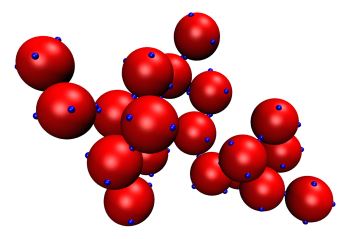
Mica, a common mineral found in granite, and has been extensively studied from geological, chemical, and technical perspectives. But recently a team from the Vienna University of Technology presented a study that explains the distribution of potassium ions on the mica surface. The researchers used a new type of atomic force microscope to conduct their investigation. Prior to this, the physical surface details of mica have never been studied on an atomic scale.
Atomically thin layers 2D materials are currently one of the most researched topics in materials science: Certain materials, such as graphene and molybdenum disulfide, consist of only one or a few layers of atoms, which frequently leads to unusual properties.
In a sense, mica is a naturally occurring 2D material: It consists of atomically thin layers that can contain different atoms depending on the type of mica: oxygen is always present, often silicon, often potassium or aluminum as well. The layer structure of the mica is also the reason for its characteristic sheen. A spectrum of colors, similar to a thin layer of oil on a puddle of water, is often visible.
The outermost layer of mica is difficult to examine because it is quickly contaminated by atoms and molecules from the air. It has now been possible to image the surface of mica in ultra-high vacuum, however, using a new type of atomic force microscope at the Vienna University of Technology.
“We were able to see how the potassium ions are distributed on the surface,” says Giada Franceschi, the first author of the current paper, who works in Prof. Ulrike Diebold’s team. “We were also able to gain insights into the positions of the aluminum ions under the surface layer—this is a particularly difficult task experimentally.”
The images from the Vienna University of Technology show that the potassium ions are not randomly distributed on the surface, as previously assumed, but are arranged in tiny patterns. These distributions could also be calculated with the help of computer simulations.
This work could be important, among other things, for attempts to use 2D materials such as graphene for electronic circuits. Suitable insulators are needed for this—and mica is an obvious candidate. “The surface properties of mica will play a crucial role in such electronic components,” says Giada Franceschi.
The team’s research was published in the journal Nature Communications (“Resolving the intrinsic short-range ordering of K+ ions on cleaved muscovite mica”).
Image – Atomic structure of mica and a picture taken by an atomic force microscope. Courtesy of TU Vienna.
************
For more information:
Vienna University of Technology