Proton-exchange membrane fuel cells that directly convert chemical energy from hydrogen to electricity have been an attractive zero-emission power-generation technology. Inside the cells, the membrane is laced with a catalyst, such as a platinum alloy, which helps spark and speed up the otherwise sluggish chemical reaction that converts the energy stored in hydrogen atoms to electricity. The reaction breaks hydrogen atoms into their constituent protons and electrons, with water vapor being the reaction’s only emission byproduct. This is why adopting fuel-cell vehicles for widespread use offers an attractive option for meeting climate sustainability goals.
However, it has been difficult to find the sweet spot between achieving catalytic efficiency and fuel cell durability because the platinum dissolves over time, dropping the fuel cell’s performance.
“A major challenge in wider fuel cell adoption continues to be making their optimal performance last long enough to be commercially viable,” said Huang, who holds the Traugott and Dorothea Frederking Endowed Chair at UCLA Samueli. “Our research demonstrated an atomic interior scaffold that holds platinum atoms in place in the catalyst so they remain stable over an extended period of time.”
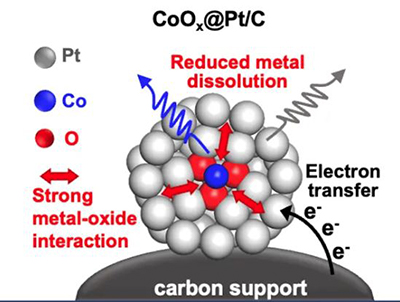
Rather than using a traditional platinum alloy, the researchers embedded clusters of cobalt-oxide molecules inside shells of platinum atoms. The design leverages the strong platinum-oxide interaction, which makes the catalyst more durable structurally and chemically without sacrificing fuel cell activity. The resulting hybrid structure helps the platinum ions stick and stay together despite extended use, reducing catalyst-replacement costs. In their experiments, the researchers saw this design outperformed traditional platinum-cobalt alloys in durability and longevity. The team also verified the nanoscale structure using a suite of microscopic, spectroscopic and simulation techniques.
For more information: Nature Catalysis