Electronics that will be launched into space or used in military operations need to operate reliably under the most challenging conditions. The University of Texas at Dallas has opened a new research center to advance semiconductor technology and test electronics in this highly specialized field.
The Center for Harsh Environment Semiconductors and Systems (CHESS) addresses a demand for materials and devices that can withstand extreme temperatures, radiation, and extreme mechanical conditions. CHESS is the first initiative of UT Dallas’ new North Texas Semiconductor Institute (NTxSI), which aims to accelerate semiconductor innovation, entrepreneurship, and workforce development in North Texas.
Dr. Manuel Quevedo-Lopez, director of CHESS, explains that microelectronic devices capable of operating in harsh environments are vital for national defense in applications such as quantum computing; resilient networks and communication systems; resilient electrical grids; autonomous vehicles; space exploration; and hypersonic weapons, which travel beyond Mach 5, five times faster than the speed of sound (Mach 1).
“Harsh-environment electronics research has become key in industry and national security, and the demand for expertise in this area is growing. CHESS brings together experts who can advance the technology and solve challenges in this highly specialized area,” says Quevedo-Lopez, department head of materials science and engineering and the TI Distinguished University Chair in Nanoelectronics in the Erik Jonsson School of Engineering and Computer Science.
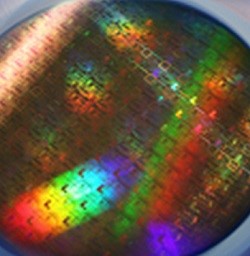
Semiconductor chips — also called semiconductors, microchips, or integrated circuits — process, store and receive information. Typically made from thin slices of silicon, one chip can include tens of billions of transistors, or electrical switches, in an area smaller than a fingernail. Extreme heat or radiation can cause a semiconductor to fail.
The effort to develop the NTxSI began more than a year ago to address the need for a coordinated effort in semiconductor research in North Texas and to help alleviate the shortage of skilled employees for the growing semiconductor industry in the region, Quevedo-Lopez says. The new institute positions UTD to contribute to the goals of the recently enacted federal CHIPS and Science Act of 2022. The CHIPS (Creating Helpful Incentives to Produce Semiconductors) Act provides $52.7 billion in incentives over five years for American semiconductor research, development, manufacturing, and workforce development.
While the U.S. is a leader in semiconductor design, most manufacturing has shifted out of the country over the past 30 years, leaving the country vulnerable to supply chain disruptions, according to an April 2021 study by the Semiconductor Industry Association. In North Texas, Texas Instruments (TI), Coherent, and Globitech Inc. are constructing new semiconductor manufacturing plants in Sherman. The new plants, along with an expanded Richardson TI facility, are expected to boost the region’s position in the industry.
As the local semiconductor manufacturing industry grows, institute officials estimate that the new manufacturing facilities will create over 17,000 semiconductor manufacturing, technology development, and management jobs over the next few years. The institute hosted a one-day Workshop for North Texas Semiconductor Workforce Development in December 2022 to meet with leaders of local semiconductor companies to discuss workforce needs.
In addition to its focus on workforce development and harsh-environment electronics research, the NTxSI plans to develop a venture startup accelerator and an advanced prototyping facility to help entrepreneurs in the semiconductor industry. These future initiatives will address the high capital costs facing startups and small businesses in the industry and the lack of access to fabrication facilities.
For More Information: North Texas Semiconductor Insitute
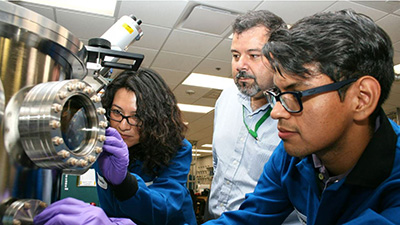
Image: Dr. Manuel Quevedo-Lopez (center) works in his UT Dallas lab with Dr. Isabel Pintor — who earned her Ph.D. at UTD in 2019 — and Dr. Martin Reyes. The researchers are depositing films to fabricate sensors used for radiation detection in harsh environments. Quevedo-Lopez is the director of the new Center for Harsh Environment Semiconductors and Systems.