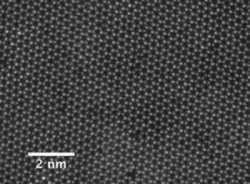
Researchers at Rice University in Houston and Nanyang Technological University in Singapore have developed a potentially scalable CVD method for making one-atom-thick layers of molybdenum diselenide. This semiconductor material is similar to graphene but has better properties for making devices such as switchable transistors and light-emitting diodes. TheSEM image shows the individual atoms in a two-dimensional sheet of molybdenum diselenide. The finding is significant because CVD is widely used by the semiconductor and materials industries to make thin films of silicon and carbon fibers.
“This new method will allow us to exploit the properties of molybdenum diselenide in a number of applications,” said study leader Pulickel Ajayan, chair of Rice’s Department of Materials Science and NanoEngineering. “Unlike graphene, which can now easily be made in large sheets, many interesting 2-D materials remain difficult to synthesize. Now that we have a stable, efficient way to produce 2-D molybdenum diselenide, we are planning to expand this robust procedure to other 2-D materials.”
In the Rice study, Ajayan and colleagues tested their atomically thin layers of molybdenum diselenide by building a field effect transistor (FET), a commonly used device in the microelectronic industry. Tests of the FET found the electronic properties of the molybdenum diselenide layers were significantly better than those of molybdenum disulfide; the latter is a similar material that has been more extensively studied because it was easier to fabricate.