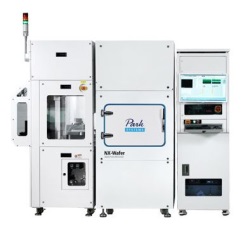
Bruker Nano Surfaces Division, Tucson, Ariz., announces the release of Inspire, the first integrated scanning probe microscopy infrared system for 10-nm spatial resolution in chemical and materials property mapping. The system incorporates Bruker’s proprietary PeakForce IR mode to enable nanoscale infrared reflection and absorption mapping for a wide range of applications. These include the characterization of chemical heterogeneity in complex materials and thin films.
The Inspire system features sensitivity down to molecular monolayers, even on samples not amenable to standard atomic force microscopy techniques. Inspire utilizes fully integrated infrared scattering, scanning near-field optical microscope (SNOM) optics, point-and-click alignment, and the full suite of exclusive PeakForce Tapping technologies. The resulting Inspire solution provides instant access to the highest resolution chemical, plasmonics, nanomechanical, and electrical characterization.
“The infrared scattering SNOM technique has great potential for new scientific discoveries through highest resolution spatio-spectral imaging,” explained Professor Markus B. Raschke, Departments of Physics and Chemistry, and JILA, at the University of Colorado, Boulder. “Its wide, productive application has been held back by the lack of an integrated solution.”
Inspire includes all optics, detectors and configurable sources, as well as all AFM hardware and software for atomic resolution imaging in a compact and robust integrated package. Inspire also comes with Bruker’s new PeakForce IR mode, which builds on Bruker’s exclusive PeakForce Tapping direct force control technology. PeakForce IR overcomes the limitations of contact and of TappingMode, and thus of traditional near-field optical and photothermal approaches to nanoscale infrared imaging.
It also avoids sample damage from lateral forces, retaining highest resolution on soft polymers, and enables high-resolution imaging of polymer brushes and even powders. PeakForce IR includes ScanAsyst self-optimization and PeakForce QNM for instantly correlated nanomechanical data. The comprehensive set of optional modes includes PeakForce TUNA™, which enables conductivity mapping on samples not amenable to contact mode AFM, and PeakForce KPFM, which employs FM detection for the highest spatial resolution work function mapping while avoiding the mechanical cross-talk affecting single-pass FM-KPFM.