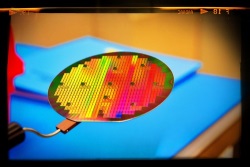
New York State and more than 100 companies, led by General Electric, Schenectady, N.Y., will collaborate to launch the New York Power Electronics Manufacturing Consortium at the SUNY College of Nanoscale Science and Engineering in Albany. GE will be a lead partner in the consortium, which will invest over $500 million to develop and produce low-cost, high-performance 6-in. silicon-carbide wafers. These SiC-based devices have significant advantages over silicon metal, including the capacity to handle much higher frequencies and temperatures, enabling reduced size and cost for filtering and cooling systems.
Power management chips move electricity (watts), not data (bytes). Their circuits help extend battery life and reduce power consumption for a broad range of devices: from smartphones and tablets to wind farms, brain scanners, and jet engines. They can make machines smaller, lighter, and more efficient. Silicon carbide chips can work at temperatures over 400°F, where ordinary silicon chips falter. They handle megawatts of power, an order of magnitude higher than silicon, and operate at much higher frequencies, which makes them much more efficient.
Additionally, the devices can be half the size of similar silicon devices, providing increased power density and reliability. However, in its current stage of development, SiC technology can be cost-prohibitive for smaller to medium size companies. All NY-PEMC partner companies will have access to state-of-the-art 6-in. SiC tools and a baseline process flow, contributed by GE, where they can make their own enhancements in preparation for high-volume, cost-effective manufacturing.
The site will serve as a global “open-innovation” user-shared facility, which will enable the expansion and growth of major corporate partners, as well as small and medium-sized enterprises.
The partnership is enabled by the START-UP NY tax free initiative, in addition to $135 million in New York State funds provided to CNSE for the establishment of the NY-PEMC facilities, which will attract $365 million in private funds and know-how to support personnel, equipment and process flow, tool installation, facilities and materials for a total 5-year investment of $500 million.