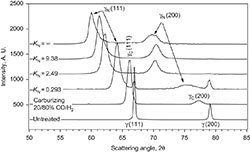
The graph shows X-ray diffraction patterns of nitrided (and carburized) stainless steel AISI 316. Carburizing was carried out in 20% CO-80% H2 gas atmosphere at 515°C (788 K) for five hours. X-ray diffraction analysis corroborates that the nitrogen content is significantly higher in the sample nitrided at the highest nitriding potential. The 111 Bragg reflections (peaks) are shifted to lower scattering angles, where the largest shift is observed for the highest nitriding potential.
The peak shift is caused primarily by dissolution of nitrogen, leading to a dilation of the fcc lattice; residual stress and stacking faults also contribute. Peaks originating from the unexpanded austenite are visible in the sample nitrided at KN = 0.293, indicating that the γN zone is not as thick as for the samples nitrided at high potentials.
Volume 4D, Heat Treating of Irons and Steels ⇒ Heat Treated High-Alloy Steels ⇒ Low-Temperature Surface Hardening of Stainless Steel ⇒ Gaseous Low-Temperature Surface Hardening of Austenitic Stainless Steel