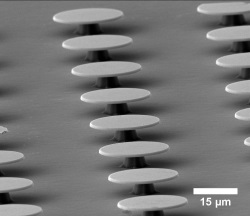
Engineering researchers at the University of Arkansas in Fayetteville have developed an infrared detector made of thin films of GeSn semiconductor material deposited on a silicon substrate. The researchers tested and measured the device at various percentages of material composition and at temperatures ranging from 77 to 300K. The material has potential for other applications such as lasers and high-efficiency solar cells.
“The performance of these simple structures indicates a promising future for germanium tin photodetectors,” says Fisher Yu, associate professor of electrical engineering. “The crystalline growth of these samples in a commercially available reactor allows for these infrared detectors to be available for immediate commercial implementation.”
Prof. Yu and colleagues Wei Du, postdoctoral fellow in the Department of Electrical Engineering; Benjamin Conley, doctoral student in the microelectronics-photonics graduate program; and Hameed Naseem, professor of electrical engineering, built the devices using a process allowing thin films of germanium tin to be deposited on silicon, without damaging integrated circuits.
The research group is collaborating with Advanced Semiconductor Materials International, a private company that builds most machine-epitaxy tools for fabricating microelectronics devices. The researchers have also started Arktonics, a spin-off company based in Arkansas, to commercialize the materials and devices.
The researchers received funding from the National Science Foundation, the Army, the Air Force, and the Defense Advanced Research Projects Agency. Their findings were published in a recent issue of Optics Express.