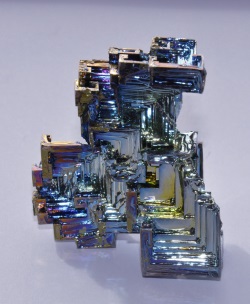
The European Space Agency, Paris, has joined forces with other leading research institutions and more than 180 European companies in a billion-euro effort to develop new types of metals and manufacturing techniques.  Known as Metallurgy Europe, the seven-year international program goal is to develop the technical foundations for the discovery of new materials – metallic compounds, alloys, composites, superconductors, and semiconductors. The photo shows a bismuth crystal, such as those used in thermoelectric compounds and special bearing alloys.
The various branches of the metals-related industry today account for 46% of the EU’s manufacturing value and 11% of its total Gross Domestic Product – equivalent to $1.7 trillion annually or $4.5 billion daily. Metallurgy Europe is conservatively projected to create at least 100,000 new jobs, based on the ten million people today employed by the metals and end-user industries across the EU plus Switzerland and Norway.
Organized along 13 topics, the potential results include novel heat-resistant alloys for space and nuclear systems, high-efficiency power lines based on superconducting alloys, thermoelectric materials converting waste heat into power, new catalysts for the production of plastics and pharmaceuticals, bio-compatible metals for medical implants, as well as high-strength magnetic systems.
The Metallurgy Europe program is being organized as a ‘Cluster’ of the EUREKA network. EUREKA is a long-established intergovernmental organization uniting more than 40 governments, including virtually all the member states of the EU.
EUREKA Clusters are long-term, strategically significant public-private partnerships, working with Europe’s leading companies to develop competitiveness-boosting technologies.
More than 180 industrial partners have signed up, including some of the largest engineering companies in the continent: Airbus Group, BP, Siemens, Daimler, Rolls-Royce, Thales, AvioAero, BAE Systems, Philips, Ruag, Bombardier, Linde Group, Rolex, Richemont, ArcelorMittal, Sandvik, Bruker, Johnson Matthey, Tata Steel, Boston Scientific, ThyssenKrupp, Outokumpu, Hydro Aluminium and Fiat, along with small and medium firms.