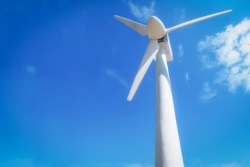
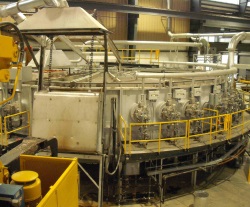
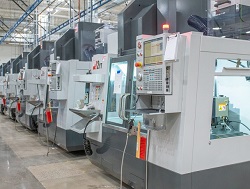
Keystone Tower Systems, Somerville, Mass., is developing a system that adapts a traditional pipe-making technology to make wind turbines on location at wind farms, making taller towers more economical. A modification of spiral welding, the system involves a process in which steel sheets are fed into a machine in which they are continuously rolled into a spiral, while their edges are welded together to create a pipe.
The process allows the steel rolls to be tapered and made of varying thickness, to create a conical tower. The automated process uses about one-tenth the labor of traditional construction, because it is made of steel to make the entire tower, instead of concrete.
With Keystone’s onsite fabrication, manufactures can make towers that reach more than 400 feet. Wind that high can be up to 50% stronger and is not blocked by trees. A 460-foot tower, for instance, could increase energy capture by 10 to 5% compared with today’s more common 260-foot towers. For 450-foot, 3-megawatt towers, a base 20 feet in diameter will suffice. (Increasing diameters by even a few feet can make towers almost twice as strong to handle stress.)
Keystone is now conducting structural validation of towers built by its system in collaboration with structural engineers at Northeastern University and Johns Hopkins University. For the past year, the startup has been working toward deploying a small-scale prototype (about six stories high) at the MIT-owned Bates Linear Accelerator Center in Middleton, Mass., by early 2015.