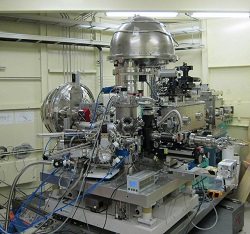
Binghamton University, New York, announces that the school will acquire a HArd x-ray Photoelectron Spectroscopy system (or HAXPES), which allows researchers to get detailed information about a device or material without taking it apart. The $1.75M system — the third of its kind in the world and the first outside of Europe — will be funded by $1.23M from the National Science Foundation’s Major Research Instrumentation program and additional money from the campus.
HAXPES relies on the photoelectric effect, one of the most important tools in condensed matter physics and in materials science. The instrument shines light (in this case hard x-rays) into a material. The material absorbs the energy and momentum and emits electrons. Conservation of energy and momentum allows researchers to determine the chemical and electronic structure of the material.
Compared to similar instruments, HAXPES offers more kinetic energy, which means excited electrons have a greater chance of escaping from deeper within the solid. That increases the tool’s sensitivity to the bulk of a material being examined. “Bulk” is a relative term in this case; HAXPES may go 60 nanometers deep into a material versus 5 nanometers with other tools.
Still, at 60 nanometers, scientists will be able to access interfaces of real devices such as transistors. They’ll be able to measure energy levels and the chemical composition of buried interfaces without tearing them apart.
The HAXPES, made by European company Scienta-Omicron, should be ready for use within two years at Binghamton’s Smart Energy Building, part of the Innovative Technologies Complex.