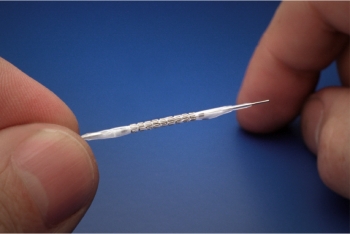
A platinum-chromium alloy makes coronary stents stronger, more flexible and resistant to corrosion. Now, Department of Energy National Lab scientists are winning an award for their work on the development, transfer and successful commercialization of the novel alloy.
The researchers from the National Energy Technology Laboratory (NETL), Morgantown, W. Va., will receive a 2015 ASM Engineering Materials Achievement Award from the materials science and engineering society ASM International, Materials Park, Ohio. NETL’s Paul Jablonski, Paul Turner, Edward Argetsinger, and Jeffrey Hansen developed the alloy in collaboration with researchers at Boston Scientific Corp., Marlborough, Mass.
The alloy is the first stainless steel formulation for stents with a significant concentration of platinum, making it easier for coronary specialists to see the stent on x-ray during placement and expansion. The alloy also increases the stents’ corrosive resistance, strength and flexibility. Stents made from the alloy benefit patients by shortening recovery time and avoiding follow-on procedures and more invasive surgery, which reduces healthcare costs.
Since their commercial introduction in 2010, the stents have helped more than 2.5 million people, generated more than $6 billion in sales and captured a 25 percent share of the coronary stent market. Engineered and manufactured in the U.S., the stent series has created 450 sustainable domestic jobs.
Image caption — This coronary stent is made with a lab-developed, award-winning platinum-chromium alloy. Courtesy of NETL.