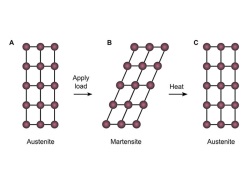
A team at the Massachusetts Institute of Technology, Cambridge, together with two collaborators in Singapore, has reportedly developed a way to make minuscule ceramic objects that are not only flexible, but also have a “memory” for shape. The team accomplished this in two key ways. First, they created tiny ceramic objects, invisible to the naked eye. Then, the researchers concentrated on making the individual crystal grains span the entire small-scale structure, removing the crystal-grain boundaries where cracks are most likely.
“When you make things small, they are more resistant to cracking,” Prof. Christopher Schuh says. Those tactics resulted in tiny samples of ceramic material — samples with deformability equivalent to about 7% of their size.
“Usually if you bend a ceramic by 1%, it will shatter,” Prof. Schuh says. But these tiny filaments, with a diameter of just 1μ, can be bent by 7 to 8% repeatedly without any cracking.
Therefore, these materials could be important tools for those developing micro- and nanodevices, such as for biomedical applications. For example, shape-memory ceramics could be used as microactuators to trigger actions within such devices — such as the release of drugs from tiny implants. Compared to the materials currently used in microactuators, the strength of the ceramic would allow it to exert a stronger push in a microdevice. The ceramics used in this research were made of zirconia, but the same techniques should apply to other ceramic materials.
The Deshpande Center for Technological Innovation at MIT has awarded $976,000 in grants to fourteen MIT research teams currently working on early-stage technologies. The shape-memory ceramic received one of these grants.