X-ray photoelectron spectroscopy (XPS) is one of the most sensitive and informative surface analysis techniques available. But it requires a high vacuum to operate, which makes analyzing materials in liquid and gaseous environments difficult.
Now, researchers from the National Institute of Standards and Technology (NIST), Gaithersburg, Md., ELETTRA, Italy; and Technical University of Munich, Germany found that graphene could make using XPS to study materials in these environments much less expensive and complicated than the conventional approach.
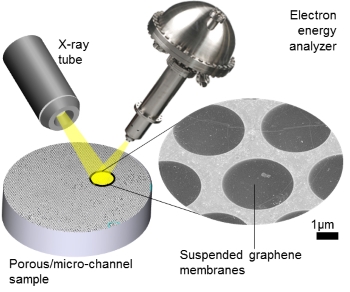
XPS works by bombarding the surface under study with x-rays. The atoms on the surface of the material absorb the x-ray energy and re-emit that energy as photoelectrons. Scientists study the kinetic energy and number of the emitted electrons for clues about the sample’s composition and electronic state.
Because x-rays and photoelectrons interact with the air, XPS has to be performed under high vacuum, which makes it hard to study materials that have to be in a pressurized environment. Researchers need a window material nearly transparent to x-rays and photoelectrons, but impermeable to gases and liquids and strong enough to withstand the mechanical stress of one atmosphere’s worth of pressure.
Graphene use as a window to separate sample stage’s atmospheric pressure liquid compartment from the high-vacuum conditions inside the electron spectrometer was explored. According to NIST researcher Andrei Kolmakov, results demonstrate that more than enough x-rays—and resultant photoelectrons—are able to pass through the graphene window to produce good quality XPS data from liquids and gases.
As an added bonus, the intensity of radiation needed to create bubbles in water—a frequently unwanted occurrence that happens when x-rays split water into oxygen and hydrogen— was also measured. Knowing the point at which bubbles form, it is possible to define an upper limit on the intensities of x-rays (or electrons) that can be used in this approach.
“We think our work could fill a much-needed gap,” says Kolmakov. “There are many scientists whose work would benefit from using XPS at ambient pressure, but there are not enough instruments that are equipped to analyze the samples under these conditions, and the ones out there are often too costly to use. Our design is simple and has the potential to reduce costs to the level that this type of measurement could be afforded by many more labs. With this imaging capability, other researchers could, for example, learn much more about how to create longer- lasting batteries and develop safer and more effective drugs.”
The approach does come with a few challenges and limitations. Kolmakov says that the adhesion of the graphene to the surface surrounding the opening needs to be improved. Moreover, the barrage of x-rays degrades atomically thin graphene over time, so the team is planning to look for ways to mitigate that, if possible.
Image caption — Drawing shows the set-up for an x-ray photoelectron spectroscopy instrument incorporating suspended, electron-transparent graphene membranes—or windows—that separate the sample from the high-vacuum detection system. Courtesy of NIST.