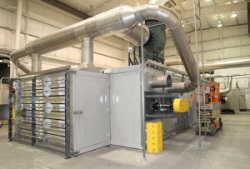
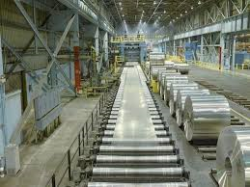
Harper International Corp., Buffalo, N.Y., offers advanced carbon fiber oxidation oven technology to complement its furnaces for carbon fiber processing. State-of-the-art oven designs are available for tow-bands from 300 mm to greater than 4000 mm. Technology advancements enable faster oxidation through elimination of the chimney effect, improved velocity uniformity and range, assurance of temperature uniformity at a variety of flow rates, and optimal control of the reaction.
Harper’s designs incorporate a multitude of improvements, including energy efficient designs. The most distinctive feature of Harper’s cutting-edge design is the innovative atmospheric end seal. This seal design reduces fugitive emissions, increases the active volume of the oven, and offers reduced energy consumption over alternatives. The seals have independent adjustment of the top and bottom inside and outside slots. Each pass has an independent vent with adjustable draw control, and the exhaust plenum connects to a dedicated fan/VFD. As a result of these innovative design features, there is no vertical mixing in the seal, less air ingress, and virtually no process gas escape.
Harper’s instrumentation improvements include a two-tier balancing methodology, responsive quench system and rapid cool down system, emissions monitoring, and inherently safer pressure relief system. Additionally, modular construction design enables up to a 90% reduction in labor versus similar field erection times into a full line pilot system (300mm).
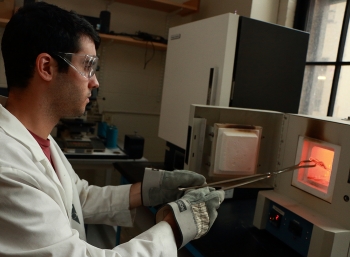
Additionally, Harper’s proprietary multiflow Research Oven offers parallel, cross, and down airflow directions in a single oven, which allows for true evaluation of different flow techniques. The oven’s uniformity specifications meet or exceed best-in-class for each flow regime.
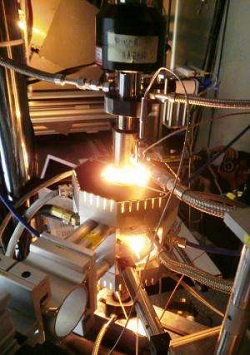
Although Carbon Fiber is predominantly produced from polyacrylonitrile (PAN) and pitch, there is an increasing necessity for alternative, low cost and renewable precursors as the industry grows to applications such automotive. Harper has the unique ability to adapt our technology to process nontraditional precursors throughout the entire thermal process.