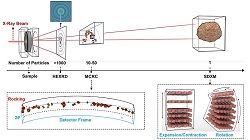
Researchers at the US Department of Energy’s Argonne National Laboratory have discovered why and how one of the more promising cathode materials in lithium ion batteries – single crystalline nickel-rich lithium nickel manganese cobalt (NMC) oxide – degrades with use.
To uncover the mechanism, the team combined multi-scale X-ray diffraction and high-resolution electron microscopy to analyze materials at the Advanced Photon Source (APS) at Argonne, the National Synchrotron Light Source at DOE’s Brookhaven National Laboratory and Argonne’s Center for Nanoscale Materials (CNM).
“The problem with electron microscopy alone is that it only provides a snapshot of a small area on a single crystal,” says materials scientist Tao Zhou, CNM. “And while X-ray diffraction offers insights into internal structures of many particles, it lacks surface-level information. Our method bridges this gap, offering a comprehensive understanding at the scale of one, 10 to 50, and 1000 particles.”
Multifaceted analyses of single-crystal cathodes provided crucial information about changes in the crystal lattice on charge and discharge. As the researchers explain, introduction of a charge triggers a strain on the lattice that causes it to expand and rotate, disrupting the neatly ordered pattern of atoms. Upon discharge, the lattice contracts to its original state, but the rotation remains. With repeated charge-discharge cycles, the rotation becomes more pronounced. This change in the cathode structure causes a steep performance drop.
The researchers highlight how the Hard X-ray Nanoprobe operated jointly by CNM and APS was critical to gaining these insights. “The team’s new method was instrumental in understanding the burning issue of why nickel-rich NMC cathodes with single crystals fail so rapidly,” points out Khalil Amine, an Argonne Distinguished Fellow. “This newfound understanding will give us ammunition to fix this issue and enable lower-cost electric vehicles with longer driving range.”
This research is published in Science.
Image – Method used for studying failure mechanisms in battery materials at sizes from 1 to 1000 particles. HEXRD (high energy X-ray diffraction), MCRC (multi-crystal rocking curve), SDXM (scanning diffraction X-ray microscopy). Lower right: lattice shape change with charge and discharge. Courtesy of: Argonne National Laboratory.
For more information:
Argonne National Laboratory
https://www.anl.gov/