NanoSteel, Providence, R.I., introduces its first powders designed for the binder jet 3D printing of parts having three times the wear and impact resistance of an equivalently infiltrated 420 stainless steel. BLDRmetal J-10 and BLDRmetal J-11 enable the 3D printing of components for highly abrasive environments that can benefit from additive manufacturing’s ability to eliminate tooling, create advanced geometries, and build custom parts on demand.
Industrial components made using J-10 feature twice the elongation and three times the wear and impact resistance of an equivalently infiltrated 420 stainless steel. NanoSteel demonstrated this capability working with 3DX Industries, an additive manufacturing service provider, to print a security tool used by a global avionics company for removing and replacing aircraft panels.
In this commercial application, the tools made with J-10 lasted five times longer than the previous solution, significantly reducing the risk of delays in servicing the aircraft.
“The NanoSteel solution enabled us to create a tool that delivered the durability and reliability the customer required in a fast turnaround environment,” said Roger Janssen, President and CEO of 3DX. The avionics service team is planning further adoption of this new technology across the global operation.
The BLDRmetal product line of binder jet powders also includes J-11, which is designed for extreme wear low-impact applications. Components made with J-11 provide ten times the wear resistance of an equivalently infiltrated 420 stainless steel. The exceptional performance of both NanoSteel products is based on the combination of complex metallic phases that provide wear resistance and a steel matrix that delivers ductility and toughness.
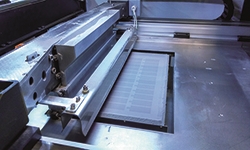
Binder jetting is a powder bed process in which a binder is used to selectively ‘print’ the part shape by adhesively joining the metal particles. After the jetting process, the green part is sintered in a furnace to burn off the binder. Then an infiltrant, typically bronze, is melted and drawn into the part to fill in the remaining spaces within the sintered metal powder skeleton to create a dense component. The resulting parts combine properties from both the metal powder and the infiltrant.