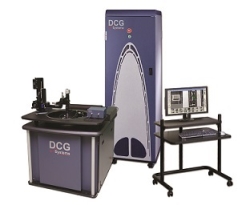
DCG Systems, Fremont, Calif., has released the Meridian M system for isolation of routine and challenging electrical faults at the wafer level. Offering photon emission for transistor-level defects and leakage, and a complete portfolio of static laser stimulation techniques for metallization defects, the Meridian M system is a critical tool to support production use cases in memory and foundry failure analysis labs. Its high-sensitivity, extended-wavelength DBX optics capture even the most challenging faults.
These faults include large-area process variation in advanced memory devices that can lead to anomalous leakage; high resistivity wordline to wordline or bitline to bitline shorts within memory cells; resistive faults in low voltage GPUs and other low-voltage logic circuits; and any weakly emitting faults requiring long integration time.
The Meridian M system also captures electrical faults that emit photons primarily in the thermal range (>1850 nm), such as partial opens, high-ohmic shorts, and electromigration.
“Static optical fault isolation (OFI) is in a renaissance,” said Praveen Vedagarbha, Ph.D., business unit manager of the Meridian product group at DCG Systems. “While dynamic OFI is important for localizing parametric faults, static OFI is faster and easier to use than its dynamic counterpart because it does not require docking to a tester or having the device and tester knowledge necessary to edit the test program. The speed and ease of use of the Meridian M system are particularly valuable in early yield ramp, when rapid feedback to the process engineering team is critical.”
Among static-only optical fault isolation systems, Meridian M has demonstrated superior performance in localizing faults with the weakest photon emission. Custom-designed optics, a set of user-selectable wavelength ranges, and the lowest background noise in the industry allow Meridian M to be optimized for a variety of fault types.
Because it accommodates full wafers in addition to packaged dies, the Meridian M system allows comparison of good die to bad die, aiding interpretation of complex thermal and photon emission images.