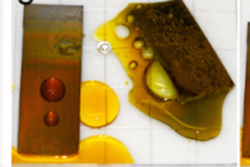
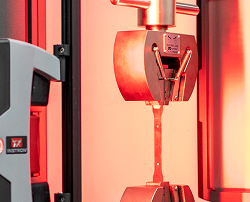
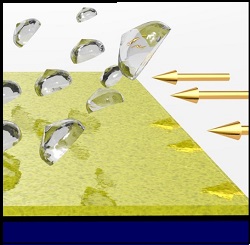
Harvard University, Cambridge, Mass., reports that a research team has developed a slippery anti-fouling coating made from nanoporous tungsten oxide that also makes steel stronger and more durable. The researchers at the Harvard John A. Paulson School of Engineering and Applied Sciences (SEAS) claim that it is the most durable anti-fouling and anti-corrosive material developed to date, capable of repelling any kind of liquid even after sustaining intense structural abuse.
“Our slippery steel is orders of magnitude more durable than any previous anti-fouling material,” said Joanna Aizenberg, the Amy Smith Berylson Professor of Materials Science, and core faculty member of the Wyss Institute for Biologically Inspired Engineering at Harvard. “So far, these two concepts – mechanical durability and anti-fouling – have been at odds with each other. We need surfaces to be textured and porous to impart fouling resistance, but rough nanostructured coatings are intrinsically weaker than their bulk analogs. This research shows that careful surface engineering allows the design of a material capable of multiple, even conflicting functions, without performance degradation.”
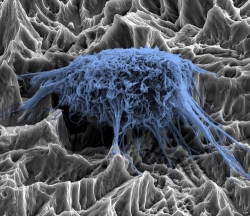
The biggest challenge was to figure out how to structure the coating to ensure its anti-fouling capability without mechanical degradation of the steel substrate. The team solved this by using an electrochemical technique to grow an ultrathin film of hundreds of thousands of small and rough tungsten-oxide islands directly onto the steel surface.