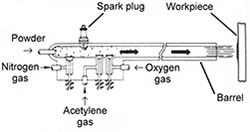
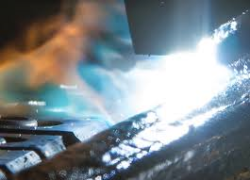
In detonation gun spraying, an explosive mixture of fuel, oxygen, and powder is introduced into a long tube/barrel and is ignited by a spark plug. The resulting detonation-pressure wave heats and accelerates the entrained powder particles, which travel down the water-cooled barrel toward the substrate. Nitrogen is used to purge the barrel between detonations.
The cycle of purging, injection, and detonation is repeated at a frequency of 3 to >10 Hz, producing packets of spray material that deposit as overlapping circles of coating material. Detonation spray processes are hotter and yield longer particle dwell times than conventional flame spray.
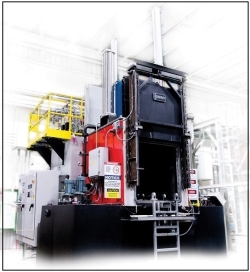
The frequency and noise levels (145+ dBA) associated with detonation spraying require that they be confined to acoustical enclosures. High particle velocities, greater than 800 m/s (2625 ft/s), are generated. These high particle velocities have been shown to improve particle deformation and increase particle/coating bonding, eliminating much of the porosity typically found in conventional flame-sprayed coatings.
Volume 5A, Thermal Spray Technology -> Thermal Spray Processes and Coatings -> Thermal Spray Processes