In a paper published in the journal Physical Review X, Yimei Zhu, a physicist at the U.S. Department of Energy’s Brookhaven National Laboratory, and his collaborators describe surprising new details about vanadium dioxide, one of the most promising neuromorphic materials. Using data collected by a unique “stroboscopic camera,” the team captured the hidden trajectory of atomic motion as this material transitions from an insulator to a metal in response to a pulse of light. Their findings could help guide the rational design of high-speed and energy-efficient neuromorphic devices.
“Vanadium dioxide is one of the rare, amazing materials that has emerged as a promising candidate for neuro-mimetic bio-inspired devices,” said Zhu.
It exhibits an insulator-metal transition near room temperature in which a small voltage or current can produce a large change in resistivity with switching that can mimic the behavior of both neurons and synapses. Those two very different physical states, intrinsic in the same material, could be encoded for cognitive computing.
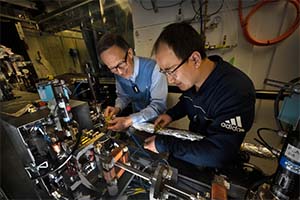
For their experiments, the scientists triggered the transition with extremely short pulses of photons—particles of light. Then they captured the material’s atomic-scale response using a mega-electron-volt ultrafast electron diffraction (MeV-UED) instrument developed at Brookhaven.
“Previous static measurements revealed only the initial and final state of the vanadium dioxide insulator-to-metal transition, but the detailed transition process was missing,” said Junjie Li, the first author of the paper. “Our ultrafast measurements allowed us to see how the atoms move—to capture the short-lived transient states—to help us understand the dynamics of the transition.”
The pictures alone don’t tell the whole story. After capturing upwards of 100,000 shots, the scientists used sophisticated time resolved crystallographic analysis techniques they’d developed to refine the intensity changes of a few dozen electron diffraction peaks.
The analysis revealed that the transition takes place in two stages, with the second stage being longer in duration and slower in speed than the first. It also showed that the trajectories of the atoms’ motions in the second stage were not linear.
The study also showed that a measure related to the intensity of light used to trigger atomic dynamics can alter atomic trajectories. To verify and confirm their experimental findings and further understand the atomic dynamics, the team also carried out molecular dynamics and density functional theory calculations. These modeling studies helped them decipher the cumulative effects of forces to track how the structures changed during the transition and supplied time-resolved snapshots of the atomic motions.
This study sheds new light on scientists’ understanding of how photoinduced electronic and lattice dynamics affect this phase transition—and should also help continue to push the evolution of computing technology.
For more information: Brookhaven National Laboratory
Image: Yimei Zhu and Junjie Li at the 3 MeV ultrafast electron diffraction instrument at Brookhaven National Laboratory’s Accelerator Test Facility. This instrument acts like a high-resolution stroboscopic “camera” to track trajectories of atoms.