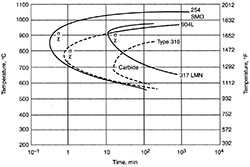
The graph shows isothermal precipitation kinetics for detrimental σ/χ phases for the 254 SMO (S31254), 904L, and 317LMN alloys. For comparison, the stability curve for the formation of chromium carbide in type 316 stainless steel is presented.
As the alloying content increases, the time to precipitate these undesirable phases decreases, and the more highly alloyed superaustenitic grades have very limited time (less than a minute) before the onset of precipitation at temperatures in the 1470 to 1700°F range.
Because of this, cooling from the anneal temperature must be controlled to maximize the quench rate and minimize the time in the 1020 to 1920°F temperature range. This is particularly a problem with thick sections, for which rapid cooling rates are difficult to achieve in the center section.
Annealing temperatures for these more highly alloyed austenitic grades tend to be higher than those of the conventional austenitic grades. These high annealing temperatures ensure dissolution of undesirable secondary phases and promote homogenization of as-solidified structures.
Volume 4D, Heat Treating of Irons and Steels ⇒ Heat Treated High-Alloy Steels ⇒ Heat Treating of Austenitic and Duplex Stainless Steels ⇒ Annealing