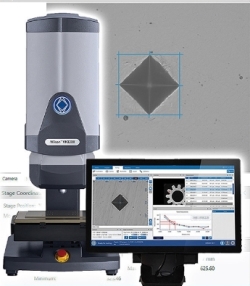
Buehler, Lake Bluff, Ill., announces that it has extensively upgraded its Wilson DiaMet hardness testing software with features designed to facilitate and accelerate specific applications, such as the documentation of the hardness distribution in welds, or the depth of hardening in induction-hardened workpieces or in objects hardened by conventional processes. The upgraded DiaMet software is said to be even more user friendly, and is consistent with international standards.
DiaMet is optimized for evaluating Macro-Vickers, Micro-Vickers, Knoop, and Brinell indents according to ISO 6507, ISO 4545, ASTM E384, ISO 6506, and ASTM E10. It is designed to work with all models of the current Wilson VH and UH hardness tester series, as well as some legacy systems.
As an international software package offered in multiple languages, the current Wilson DiaMet software addresses all relevant national and international hardness testing standards requirements.
The new design of the DiaMet testing software substantially facilitates the process of meeting ISO 9015 and ISO 15614 hardness testing of welds. The software guides the operator through the setup process by adapting a fixed test pattern to the sample in hand with only a few clicks – strictly in accordance with the standards. The software produces a graphical image of the complete weld, including indent positions and associated measurement values, which can be used in a test report.
ISO 9015 and ISO 15614 describe the test loads, number of indents in the parent material, heat affected zone, distances between each indent, and the depth below the surface of the welded joint. Fulfilling these test requirements traditionally requires a time-consuming setup and an experienced operator, not least due to the fact that no two weld samples are completely identical. DiaMet saves time and improves accuracy.
DiaMet is designed for operation under Windows 10, and can interface with Office spreadsheet applications. It fulfills the requirements for industrial hardness measurement in a production-related environment – an application requiring high precision along with a maximum degree of automation in handling extensive test programs.