Engineers at the University of California Los Angeles report that they have developed defect-free boron arsenide, a semiconductor material that is more effective at drawing and dissipating waste heat than any other known semiconductor or metal.
This could potentially revolutionize thermal management designs for computer processors and other electronics, or for light-based devices such as LEDs.
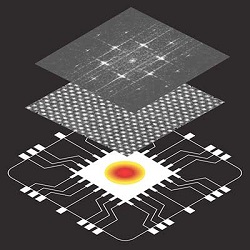
The illustration shows a schematic of a computer chip with a hotspot (bottom); an electron microscope image of defect-free boron arsenide (middle); and an image showing electron diffraction patterns in boron arsenide. The study was recently published in Science and was led by Yongjie Hu, UCLA assistant professor of mechanical and aerospace engineering.
The defect-free boron arsenide, which was made for the first time by the UCLA team, has a record-high thermal conductivity, more than three-times faster at conducting heat than currently used materials, such as silicon carbide and copper, so that heat that would otherwise concentrate in hotspots is quickly flushed away.
“This material could help greatly improve performance and reduce energy demand in all kinds of electronics, from small devices to the most advanced computer data center equipment,” Prof. Hu said. “It has excellent potential to be integrated into current manufacturing processes because of its semiconductor properties and the demonstrated capability to scale-up this technology. It could replace current state-of-the-art semiconductor materials for computers and revolutionize the electronics industry.”