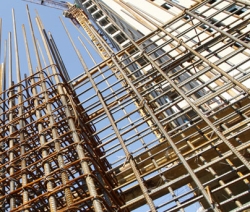
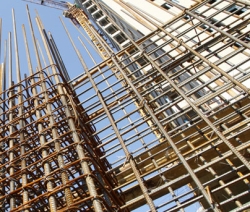
The University of Texas at San Antonio announces that its researchers have received a $248,083 grant to support R&D to increase the strength of concrete rebar. The grant comes from a consortium of construction-oriented agencies: the Charles Pankow Foundation, the Concrete Reinforcing Steel Institute, and the American Concrete Institute.
“The bulk of all construction in the world is concrete-based,” says Wassim Ghannoum, director of the research and associate professor of civil and environmental engineering. “Concrete is very strong in compression, but very weak in tension. You can easily just crack it. The steel rebar takes the tension loads.”
Rebar in use today first became common in the 1940s, and the most widely used type had a tensile strength of 40 ksi. In the 1960s, American construction moved to 60 ksi bars, which have been the standard ever since. Now, Prof. Ghannoum is testing new rebar with tensile strength up to 100 ksi , to determine if it could become the new standard.
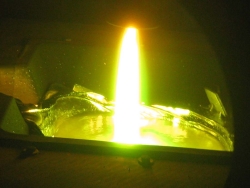
“We’re going to hone in on exact properties,” he said. “Above all, we want to know the exact strengths of the steels we develop, as well as their ability to resist breakage, and their functional lifetimes.” He also noted that in Texas, where a large portion of the rebar used in U.S. construction projects is forged, switching to a stronger steel could have positive environmental effects. Since sturdier rebar means less of it will be needed in construction, the energy saved could be considerable
Prof. Ghannoum is set to begin the two-year project this fall, with a small group of UTSA graduate students to aid him. He’s working with the five largest steel mills in the United States to establish specifications for 80 and 100-grade bars, which will entail a good deal of testing. Ann ultrasonic testing machine to help simulate a host of conditions, including earthquakes, will soon be on the way to Ghannoum’s laboratory.