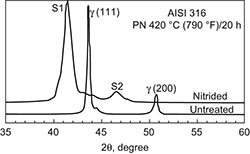
The success of plasma and gas nitriding at low temperatures (lower than 840°F) and solution nitriding at high temperatures is associated with the absence of chromium nitride or carbide precipitation, and thus with the formation in the surface layer of a particular phase called the S-phase. This nitrogen- and/or carbon-rich phase presents higher concentration of the interstitials when treated at lower treatment temperatures and when high-chromium alloys are used, resulting in better properties.
The figure shows the XRD patterns of untreated and plasma-nitrided AISI 316 stainless steel at 790°F. It illustrates the displacement of the peaks corresponding to the γ-phase to the left, with increasing nitrogen, as well as the broadening of these peaks, compared to the γ-phase peaks of the untreated steel.
Volume 4D, Heat Treating of Irons and Steels ⇒ Heat Treated High-Alloy Steels ⇒ Nitriding of Stainless Steels ⇒ Stainless Steels