Plasma nitriding is a surface-hardening process in which glow-discharge technology introduces nascent (atomic) nitrogen into the surface of a metal part for subsequent inward diffusion. The process takes place in a vacuum chamber, with the workpiece as the cathode (negative potential) in a nitrogen/hydrogen atmosphere at pressures between 100 and 1000 Pa (0.015 and 0.15 psi).
A voltage in the range of 500 to 1000 volts is applied between the metal part and the chamber wall, resulting in the formation of a plasma through which positive nitrogen ions are accelerated against the negative-biased part to be treated. This ionic bombardment heats the piece to the treatment temperature, cleans the surface by sputtering, and provides active nitrogen species for the nitriding process.
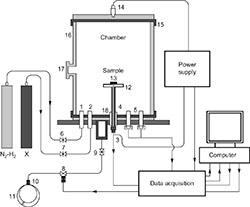
The diagram shows the schematic of a device used for glow-discharge plasma nitriding. 1 and 2, gas introduction; 3, thermocouple; 4, cathode; 5, pressure sensor, 6 to 8, needle valve; 9, diaphragm valve; 10, solenoid; 11, vacuum pump; 12, sample holder; 13, sample; 14, anode; 15, sealing ring; 16, stainless tube; 17, window and 18, insulator.
Volume 4D, Heat Treating of Irons and Steels ⇒ Nitriding of Stainless Steels ⇒ Thermochemical Nitriding Treatments