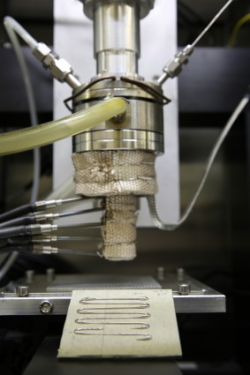
Cornell University, Ithaca, N.Y., announces that its physicists have developed an electron microscope pixel array detector (EMPAD) for scanning transmission electron microscopes (STEM) that extracts much more information from the image than possible with conventional detectors. “We can extract local strains, tilts, rotations, polarity, and even electric and magnetic fields,” explains David Muller, professor of applied and engineering physics. He developed the new device with Sol Gruner, professor of physics, and members of their research groups.
Cornell’s Center for Technology Licensing has licensed the invention to FEI, a division of Thermo Fisher Scientific. FEI expects to complete the commercialization of the design and offer the detector for new and retrofitted electron microscopes this year.
The scientists described their work in the February 2016 issue of the journal Microscopy and Microanalysis.
In the usual STEM, a narrow beam of electrons is fired down through a sample, scanning back and forth to produce an image. A detector underneath reads the varying intensity of electrons coming through and sends a signal that draws an image on a computer screen.
The EMPAD that replaces the usual detector is made up of a 128×128 array of electron-sensitive pixels, each 150 microns square, bonded to an integrated circuit that reads out the signals. Its purpose is to detect the angles at which electrons emerge, as each electron hits a different pixel. The EMPAD is a spinoff of X-ray detectors the physicists have built for X-ray crystallography work at the Cornell High Energy Synchrotron Source, and it can work in a similar way to reveal the atomic structure of a sample.
Combined with the focused beam of the electron microscope, the detector allows researchers to build up a “four-dimensional” map of both position and momentum of the electrons as they pass through a sample to reveal the atomic structure and forces inside. The EMPAD is unusual in its speed, sensitivity, and wide range of intensities it can record – from detecting a single electron to intense beams containing hundreds of thousands or even a million electrons.