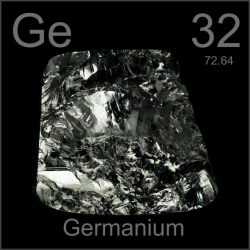
The University of Michigan, Ann Arbor, reports that its chemists have invented a method to simultaneously synthesize and deposit germanium crystalline semiconductor films from water at room temperatures using equipment that can be assembled for just a few dollars.
“Our method doesn’t require excess heat, and everything is done in an aqueous solution, so we do not need any toxic precursors,” says Prof. Stephen Maldonado. “And we’re doing this without sacrificing any quality in the crystallinity of the material, which is usually the trade-off.”
To do this, Prof. Maldonado and his team make a thin, liquid-metal film that rests on a substrate that they connect to a power supply. When they electrify the metal film, molecules on the surface of that film—if they’re in contact with water—can be reduced into their elemental parts. In this case, units of dissolved germanium oxide are transformed into germanium atoms that dissolve into the liquid metal film.
“If the liquid metal film is thin enough, the germanium atoms will precipitate out, but selectively at the bottom, and as a uniform crystalline film,” he says. “The cool thing is that we’re taking an oxidized precursor—like what you would find in nature—and in one process step, we can produce a technologically relevant film that is one large contiguous crystal.”
“This process, in terms of the key elements of it—we’re talking about stuff you can get at RadioShack. You don’t need high temperature, you don’t need elaborate machinery. You just need a means to draw and measure a current, but the electronics you could literally put together for $20. This work is a step towards a semiconductor manufacturing industry that could be run by anyone, anywhere.”
The team’s research has been published in the Journal of the American Chemical Society.