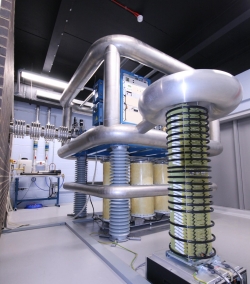
The University of Huddersfield, England, announces the completion of a $4.5 million research facility that includes a transmission electron microscope and a dual-beam ion beam accelerator. This combination tool is designed for the investigation of issues ranging from nuclear technology and nanoparticles, to semiconductors and the effects of radiation exposure on materials in space.
First came MIAMI – standing for Microscope and Ion Accelerator for Materials Investigations. It was designed and built by Professor Steve Donnelly, the University’s Dean of Computing and Engineering; Professor Jaap van den Berg of the International Institute for Accelerator Applications; and Dr Jonathan Hinks, a Reader in Radiation Damage in Materials at the University.
Now referred to as MIAMI-1, the original facility was a custom-designed combination of ion accelerator with an electron microscope, enabling nanoscale investigation of radiation damage, and is still a valuable research tool. It has now been joined by the more powerful, versatile, and much larger MIAMI-2, which has dual ion beams and greatly enhanced analytical capabilities.
The Engineering and Physical Sciences Research Council (EPSRC) awarded $4.5 million for the development and construction of MIAMI-2, which has required the construction of an additional floor at the laboratory complex in which it is housed.
Designed and constructed in collaboration with major companies such as Bruker, Hitachi, Gatan, and National Electrostatics Corporation – all of which have contributed major components – MIAMI-2 will have an official launch later in the year, but it is already operational and being used for experiments, said Dr Hinks.
“For example, we were working with some Belgian colleagues only last week who are looking at novel materials they have developed for next-generation nuclear reactors.”
Demand is already high to use MIAMI-2, and will increase even further now that the University of Huddersfield has become one of the three UK universities to form the UK National Ion Beam Centre (UKNIBC), funded to the tune of $11.3 million – again by EPSRC.
“With MIAMI-1, we have always had the core ability to observe radiation damage as it is happening, but now we have additional capabilities in terms of the analytical techniques. We can irradiate, observe, and analyze all at the same time, generating a huge volume of invaluable scientific data in a very efficient manner,” says Dr. Hinks.