Purdue University, West Lafayette, Ind., is collaborating with General Motors, Detroit, to develop a new type of energy-absorbing material that might be 3D printed and that could have an impact in areas ranging from earthquake engineering to safer football helmets.
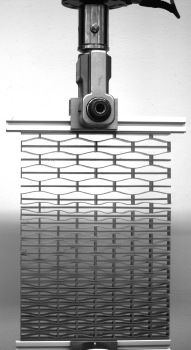
The honeycomb architecture of the phase transforming cellular materials, or PXCMs, could be scaled to a range of sizes tailored for various applications. One size could be ideal for integration into helmets to reduce head impacts, while another size would be suited for installation in the walls of buildings to dampen earthquake forces. Being able to 3D print the PXCMs would make them less expensive and more practical than other technologies, says Pablo Zavattieri, an associate professor at Purdue.
“The main advantage is that not only can it be used as an energy absorbing material, but unlike many other materials designed for this purpose the PXCMs would be reusable because there is no irreversible deformation,” he says. The structures can be made of metals or polymers or “anything that behaves elastically.”
“The ability to realize the energy absorption offered by PXCMs at various length scales makes it possible for engineers to integrate energy absorption as a secondary function into structures that are already in use,” says staff researcher Nilesh D. Mankame. “It is currently in the realm of fundamental materials research and shows a lot of promise but is not yet ready for commercial applications.”
The PXCMs contain “unit cells that have multiple stable configurations.” The structures can flex back and forth and remain in either position indefinitely, not unlike a flexing playing card (youtube video).
“It has two stable positions,” Zavattieri says. “I push it and it goes to the other position. If you remove the force and the card returns to the original position, the mechanism is said to be meta-stable. Then you could combine many of these building blocks and have bi-stable or meta-stable materials, which gives us the flexibility to design these materials for specific needs. For instance, you might need materials with meta-stable unit cells for head protection in helmets, but then maybe you would need materials with bi-stable unit cells for buildings to protect against earthquakes.”
Each configuration of the unit cell corresponds to a “stable phase,” and transitions between these phases are regarded as “phase transformations of the cellular material.”
“The energy dissipation due to the mechanical behavior of the unit cells adds to the intrinsic energy dissipation of the base material,” Mankame says. “Many emerging materials like aluminum, magnesium, and fiber-reinforced composites, that play an increasingly important role in the transportation, defense and construction industries, suffer from low intrinsic energy dissipation. The energy absorption capability of structures that are made of such base materials can be increased by incorporating PXCMs into the structures. “
The work may be extended to a variety of geometric configurations such as cubes, tetrahedral, or pentagonal for use in helmets. Like other phase-transforming materials such as shape-memory alloys, PXCMs could be controlled using heat or other external stimuli. This concept of actuation also could be used to make soft robots, which are flexible and able to conform to various shapes.
“The fact that we demonstrated that phase transforming cellular materials exhibit the same levels of energy dissipation as traditional metallic honeycombs opens the door to use these materials in a variety of applications ranging from passive dissipation dampers in high rise buildings, to human body protection,” says Mankame.
The research has been done in close collaboration with General Motors and is ongoing, recently receiving funding from the National Science Foundation.
Image caption — The honeycomb architecture of new phase transforming cellular materials, or PXCMs—energy-absorbing materials that might be 3D printed and could have applications in areas ranging from earthquake engineering to safer football helmets. Courtesy of Purdue University image/Pablo Zavattieri.