Japan’s National Institute for Materials Science and Nagaoka University of Technology announce development of a high-strength magnesium sheet alloy that has excellent formability comparable to that of the aluminum sheet currently used in body panels of some automobiles. The alloy is composed of only common metals, and is expected to be a low-cost lightweight sheet metal for automotive applications.
Magnesium alloys are roughly 75% lighter than steels and 33% lighter than aluminum alloys. However, virtually no magnesium alloys are used in automotive bodies because of their high processing cost originating from the poor formability and low strength of magnesium sheet alloys.
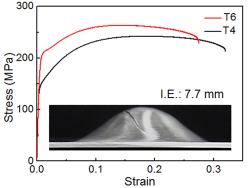
The research team recently developed a new age-hardenable magnesium alloy: Mg-1.1Al-0.3Ca-0.2Mn-0.3Zn, named AXMZ1000. The newly developed alloy has excellent room-temperature formability comparable to that of medium-strength aluminum alloys. In addition, the new alloy is 1.5 to 2.0 times stronger than the aluminum alloy.
The excellent formability was achieved by adding very small amounts of zinc and manganese, which led to the formation of fine grain structures. The high strength was achieved by adding aluminum and calcium, which induced the strengthening of the alloy by the formation of atomic clusters.
The newly developed alloy is composed of only common metals, so the material cost is not expensive. Also, it can be rolled into sheets by simple processes and heat treatments typical for aluminum alloys. The alloy overcomes the long-standing issues for magnesium namely, low strength and poor room temperature formability. As the processing cost of the new material is expected to be low, there is good potential for practical applications in automotive bodies or casing of notebook computers and cell phones.
This study was published in Scripta Materialia on June 16, 2017. M.Z. Bian et al. A heat-treatable Mg–Al–Ca–Mn–Zn sheet alloy with good room temperature formability, Scripta Materialia (2017). DOI: 10.1016/j.scriptamat.2017.05.034