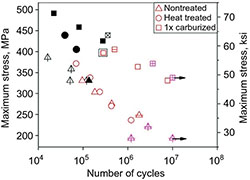
The graph shows the results of fatigue testing of standard round bar 316 stainless steel specimens, in tension-compression cycling (R = –1) The symbols represent different sets of specimens, with nontreated specimens identified by triangles, treated specimens by squares.
The effects of the thermal cycle (heat treatment without carburization) also were evaluated, and tests of these specimens are identified by circles. The thermal cycle alone did not show a significant effect on fatigue performance.
Fatigue life (number of cycles) for treated 316 stainless steel showed two orders of magnitude improvement versus nontreated 316 at the same maximum stress level. In addition, the maximum stress at 107cycles (considered to be the endurance stress for infinite life), improved by ~75%, from 200 to 350 MPa (28 to 49 ksi). Low-temperature carburized components can sustain higher stresses in alternating loading conditions, or at the same stress level, have a high-cycle fatigue life that is approximately 100 times longer than that of nontreated components.
Volume 4D, Heat Treating of Irons and Steels → Heat Treated High-Alloy Steels → Low-Temperature Carburization of Austenitic Stainless Steels → Process Considerations