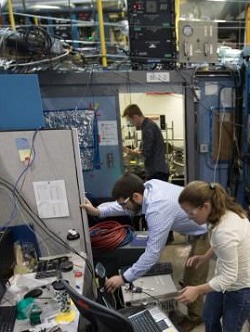
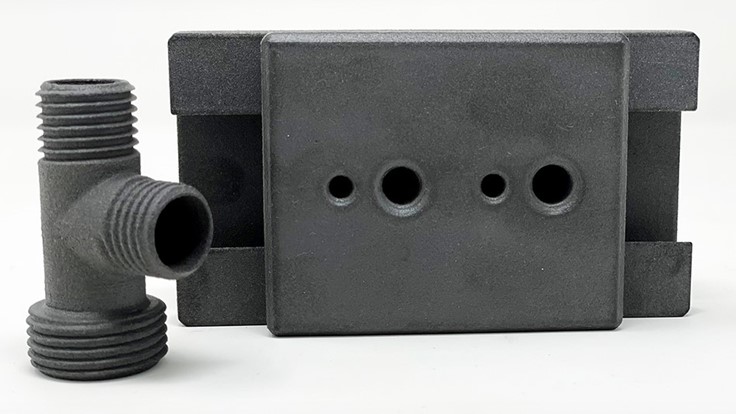
Scientists at the Department of Energy’s SLAC National Accelerator Laboratory, Stanford, Calif., are using x-ray light to observe and understand how the process of making metal parts using 3D printing can leave flaws in the finished product. The studies aim to help manufacturers build more reliable parts on the spot – whether in a factory, on a ship or plane, or even remotely in space – and do it more efficiently, without needing to store thousands of extra parts.
Metal 3-D printing is being developed for making highly specialized parts for the aerospace, aircraft, automotive and healthcare industries. Right now, companies like General Electric and Boeing that create metal parts with 3-D printing have to put each part and 3-D printer through vigorous qualification. But if the process could be better understood so it reliably prints flawless parts, the researchers said, the need for testing would diminish and the manufacturing cost could come down.
The work is taking place at the lab’s Stanford Synchrotron Radiation Lightsource (SSRL) in collaboration with scientists from the DOE’s Lawrence Livermore National Laboratory and Ames Laboratory.
The 3-D printing process, also known as additive manufacturing, builds solid, three-dimensional objects from a computer model by adding material layer by layer. The use of plastics and polymers in 3-D printing has advanced rapidly, but 3-D printing with metals for industrial purposes has been more challenging to sort out.
“With 3-D printing, you can make parts with very complex geometries that are not accessible for casting like regular metal parts,” says SLAC staff scientist Johanna Nelson Weker, who is leading the project. “Theoretically, it can be a quick turnaround – simply design, send, print from a remote location. But we’re not there yet. We still need to figure out all of the parameters involved in making solid, strong parts.”
https://www6.slac.stanford.edu/