New research at Saarland University, Germany, places International Metallography Society (IMS) board member Frank Mücklich and his colleagues in the limelight for two steel-related studies. This article highlights both developments.
Niobium mining company funds research into key steel alloying element
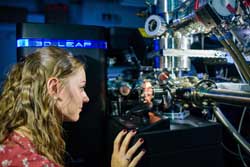
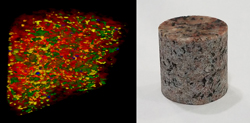
The global leader in niobium mining, Brazilian company CBMM, is funding Professor Frank Mücklich and his research team at Saarland University and Steinbeis Material Engineering Center Saarland (MECS) for three years. With the help of atom probe tomography, researchers aim to determine how niobium is incorporated within steel at the nanostructural level and how it influences the metal’s properties.
Niobium is a raw material with strong global demand, particularly in the steel industry. In pipelines, niobium ensures that the steel does not become brittle even at sub-zero temperatures. In automotive engineering, niobium makes steel stronger and also more ductile, improving the vehicle’s crashworthiness characteristics.
Niobium is used in comparatively small amounts in steel production. “Niobium accounts for only about one in every 10,000 atoms in steel. It’s therefore all the more surprising to see what a major effect these small concentrations have. The presence of niobium makes the steel tougher; it becomes more stretchable without losing its strength,” says Mücklich.
His research team specializes in performing spatial analyses of the internal structures of materials at different dimensional scales and has developed a number of 3D methods for use in this field. Over the past few years, the researchers have been able to fine-tune their techniques to develop a suite of closely aligned methods for the structural analysis of materials. “We make use of high-resolution electron microscopy, as well as nano-tomography and atom probe tomography. The information and image sequences that we produce are then fed into a computer where they are combined to generate an exact spatial representation of the material structure, in some cases right down to the level of individual atoms,” explains Mücklich.
Using their 3D analytical techniques, the researchers are now in a position to quantitatively map the internal structure of steel and to identify the mechanisms that control specific required material properties. “We want to understand the internal structure of steel as precisely as possible and we want to know the role the niobium atoms play in the steel’s microstructure and how this changes over the course of the steel production process. Only then will we be in a position to design the internal structure of the steel for a particular technical application and the desired properties. We would then know, for example, how to use niobium in the most effective way to produce superior material properties and how we can reduce other costly alloying elements or expensive process steps by targeted employing of niobium,” adds Mücklich.
Mücklich presented these precision 3D analytical techniques to an elite group of niobium researchers from around the world, who were invited to a workshop on the Saarbrücken campus last year. CBMM wants to encourage niobium research and is supporting materials research at Saarland through the project “Niobium in Steel.” The aim of the research work is not only to achieve a more detailed understanding of the mechanisms within steel, but also to improve control of the steel production process itself.
Computer scientists and materials researchers collaborate to optimize steel classification
Using machine learning techniques, computer scientists and materials scientists in Saarbrücken have now developed a method that is much more accurate and objective than conventional quality control procedures. Their results have just been published in Scientific Reports, the open-access journal associated with the scientific journal Nature.
First, the materials researchers needed to help the computer scientists understand how the internal structures of a material are related to its properties. Likewise, the computer scientists showed the materials researchers how machine learning methods are able to produce significantly more accurate results than any of the image analyses conducted manually by expert materials scientists.
During this study, which focused on classifying steel microstructures, the team needed to understand how every stage of the steel production process influences the metal’s internal structure. Traditionally, during the material development and quality control stages, samples are evaluated using optical and electron microscopy. In this case, the materials scientists were interested in finding an objective procedure that was far less prone to user error and that could be applied irrespective of the user’s level of expertise.
“Machine learning methods allow computers to recognize complex patterns very rapidly and to assign the geometry of the microstructures in microscope images. They can learn the features of previously classified microstructures and compare these with recognized patterns,” explains Mücklich, who supervised the study.
Using this approach, the research team was able to determine the microstructures of low-carbon steel at a level of accuracy not previously possible—93% accurate compared with 50% for conventional methods.
The collaborative project was able to link these two different research fields—computer science and materials research—in a constructive and rewarding manner. “The new deep learning methods will not only help us assess the quality of steel more objectively and more accurately, we also anticipate that our results will be transferable to many other production processes and materials,” adds Mücklich.
************
Image – The Atom Probe Tomography Lab of Saarland University.
More information:
https://idw-online.de/de/news?id=690234
https://www.eurekalert.org/pub_releases/2018-03/su-wls030518.php
https://www.eurekalert.org/pub_releases/2018-02/su-csa022118.php