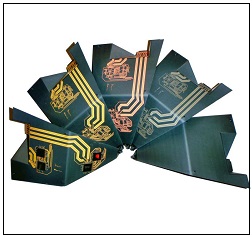
The University of Nottingham, England, reports that its researchers have pioneered a breakthrough method to rapidly 3D print fully functional electronic circuits made up of electrically-conductive metallic inks and insulating polymeric inks.
The new method combines 2-D printed electronics with Additive Manufacturing (AM) or 3D printing – which is based on layer-by-layer deposition of materials to create 3D products. This expands the impact of Multifunctional Additive Manufacturing (MFAM), which involves printing multiple materials in a single additive manufacturing system to create components that have broader functionalities.
The new method overcomes some of the challenges in manufacturing fully functional devices that contain plastic and metal components in complex structures, where different methods are required to solidify each material.
Existing systems typically use just one material, which limits the functionality of the printed structures. Having two materials, such as a conductor and an insulator, expands the range of functions in electronics. For example, a wristband that includes a pressure sensor and wireless communication circuitry could be 3-D printed and customized in a single process.
The breakthrough speeds up the solidification process of the conductive inks to less than a minute per layer. Previously, this process took much longer to be completed using conventional heat sources such as ovens and hot plates, making it impractical when hundreds of layers are needed. In addition, the production of electronic circuits and devices is limited by manufacturing methods that restrict both the form and potentially the performance of these systems.
Professor Chris Tuck, Professor of Materials Engineering and lead investigator of the study, highlighted the potential of the breakthrough, “Being able to 3-D print conductive and dielectric materials (electrical insulators) in a single structure with the high precision that inkjet printing offers, will enable the fabrication of fully customized electronic components. You don’t have to select standard values for capacitors when you design a circuit, you just set the value and the printer will produce the component for you.”
https://techxplore.com/news/2017-11-method-d-fully-functional-electronic.html