The Massachusetts Institute of Technology, Cambridge, reports that its scientists have discovered that an aluminum oxide protective coating can, when applied to bulk aluminum in sufficiently thin layers, deform as if it were a liquid, filling any cracks and gaps as they form.
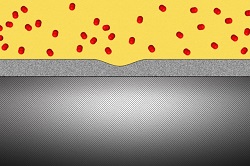
Researchers demonstrated that an aluminum oxide layer, normally so brittle it would shatter under stress, when made exceedingly thin is almost as deformable as a comparably thin layer of aluminum metal — a layer much thinner than aluminum foil. When the aluminum oxide is coated onto a surface of a bulk piece of aluminum, the liquid-like flow keeps the aluminum covered with its protective layer.
Most metals, with the notable exception of gold, tend to oxidize when exposed to air and water. This reaction, which produces rust on iron, tarnish on silver, and verdigris on copper or brass, can weaken the metal over time and lead to cracks or structural failure. However, three known elements produce an oxide that can actually serve as a protective barrier to prevent any further oxidation: aluminum oxide, chromium oxide, and silicon dioxide.
The researchers demonstrated that the aluminum with its oxide coating could be stretched to more than double its length without causing any cracks to open up. The thin coating layer should be especially useful to prevent leakage of tiny molecules that can penetrate through most materials, such as hydrogen gas that could be used to power fuel-cell cars, or the radioactive tritium (a heavy form of hydrogen) that forms inside the cores of nuclear power plants.
http://news.mit.edu/2018/self-healing-metal-oxides-could-protect-against-corrosion-0404