Alloying elements alter the Ms temperature significantly, but do not alter the characteristic that transformation is largely independent of cooling rate. In maraging steels, fully martensitic structures are formed even during very slow cooling of heavy sections from the solution-annealing temperature.
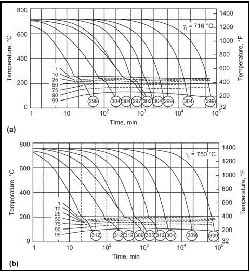
The graphs show continuous cooling transformation diagrams for 8Ni maraging alloys that were solution-treated at 845 °C (1550 °F) for 20 minutes.
(a) 18Ni Marage 200.
(b) 18Ni Marage 250.
The Vickers hardness appears in the circles at the end of each cooling curve. The horizontal lines at the bottom of each graph represent the percentage of material transformed to martensite at a given time and temperature.
As these CCT diagrams indicate, the classical diffusion-controlled bainitic and pearlitic transformations that occur in carbon-base martensitic steels are not present in the 18Ni maraging steels.
One of two possible types of martensite may form in the iron-nickel alloy system, depending on the nickel content of the material in question. At sufficiently high cooling rates, martensite will form in iron containing 5 to 10% Ni, and the addition of nickel in excess of 10% lowers the cooling rate necessary to form martensite in iron and ensures the formation of a completely martensitic structure.
This particular type of martensite is referred to as lath martensite, and it will form in iron containing up to 25% Ni. If the nickel content is increased above 25%, the lath martensitic structure is replaced by a twinned martensite.
Maraging steels typically transform from austenite to bcc lath martensite following cooling/quenching from the solution-annealing temperature, which is typically around 815°C (1500°F). Work on a series of Fe-7Co-5Mo-0.4Ti maraging alloys (18Ni Marage 250) containing various nickel levels revealed that a lath martensitic structure was obtained for nickel levels as high as 23%. However, nickel contents in excess of 23% resulted in the formation of a twinned martensite. Generally, a lath martensitic structure is preferred in maraging steels because, following aging, this structure is tougher than a twinned martensitic structure.
Volume 4D, Heat Treating of Irons and Steels -> Heat Treated High-Alloy Steels -> Heat Treating of Maraging Steels -> Martensite Formation