Thermal cycling of maraging steels between the martensite finish (Mf) temperature and a temperature considerably in excess of the solution-annealing temperature can be used to refine the grain structure of coarse-grained maraging steels. For example, Saul et al. were able to refine an ASTM grain size of 00/1 to an ASTM grain size of 6/7 in 18Ni Marage 300 following three thermal cycles between room temperature and 1025°C (1880°F).
The strains produced by the diffusionless shear transformations of martensite to austenite, and of austenite to martensite provide the driving force for recrystallization during these thermal cycles. Grain sizes finer than ASTM 6 or 7 cannot be achieved by this process, and the process becomes less effective as the starting grain size becomes finer.
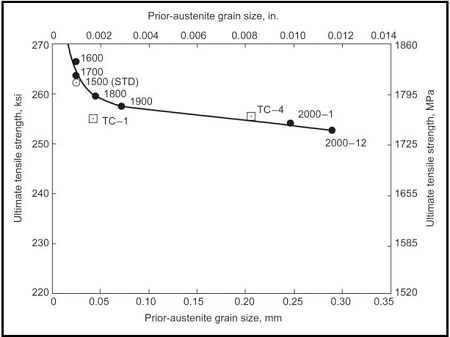
Austenite grain size reductions were dependent on the cycling temperature, cycles, and prior strain in 18% Ni (250, 300)-grade maraging steels. After a one hour solution anneal at 815°C (1500°F), thermal cycling resulted in a significant reduction of austenite grain size from large (ASTM 2) austenite grains to smaller (ASTM 7) grains. The cycle temperature was alloy dependent. Although aging at 480°C (900°F) for three hours was mentioned, it was not clear if the grain size data represented aged or austenite grain size. The optimum treatment for 18% Ni 250-grade maraging steel, previously heated at 925 to 1100°C (1700 to 2000°F) for 1 to 12 hours to first increase the grain size, was to refine grain size by thermal cycling five times from 360 to 925°C (675 to 1700°F) to room temperature. Grain size reduction was from ASTM 1 to a minimum ASTM 7.
Volume 4D, Heat Treating of Irons and Steels -> Heat Treated High-Alloy Steels ->Heat Treating of Maraging Steels -> Grain Refinement Using Thermal Cycling