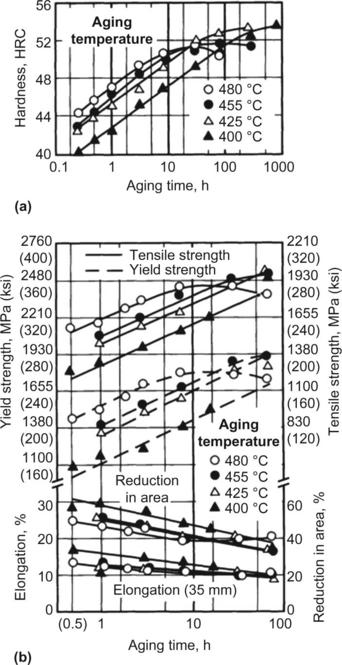
Temperature and time exert a significant influence on the properties that are developed in maraging steels during age hardening. These effects are clearly illustrated by the graphs (a) and (b) for 18Ni Marage 250. Hardening is initially very rapid, as shown by the substantial increases in hardness and tensile strength that occur after only a few minutes at the age-hardening temperature.
As aging time increases, eventually a point is reached where hardness and strength begin to decrease due to coarsening of the precipitates and formation of reverted austenite. Reverted austenite generally begins to form as rather small particles at prior-austenite grain boundaries and at packet and lath martensite boundaries.
As shown in the graphs, the time at which overaging begins to occur is a function of temperature and generally obeys known time/temperature kinetic relationships, such as the familiar Larson-Miller parameter. Figure (a) also indicates that significantly higher-aged hardness levels can be achieved in 18Ni maraging steels by aging at lower than normal temperatures for extended periods. Unfortunately, the times associated with aging temperatures in the 400 to 425 °C (750 to 800 °F) range are on the order of 300 to 1000 hours and generally are not viable for commercial production.
Volume 4D, Heat Treating of Irons and Steels -> Heat Treated High-Alloy Steels ->Heat Treating of Maraging Steels -> Age Hardening