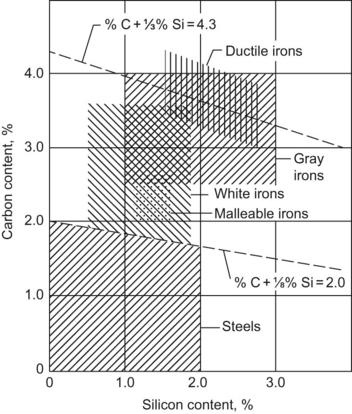
The ease with which graphite forms on cooling is determined largely by the temperature of the iron and the silicon content. High carbon and silicon are the primary alloying elements that increase the graphitization potential of the iron as well as its castability. Carbon and silicon composition ranges of common cast irons are plotted in the graph. The higher the silicon content, the lower the solubility of carbon in austenite and the more readily carbon is precipitated as graphite on slow cooling.
The carbon in cast irons can solidify into graphite with different shapes during casting. Cast irons also are classified according to the shape of graphite that forms during solidification.
There are three basic types of cast iron with distinct forms of graphite shape:
- Gray iron contains carbon in the form of graphite flakes. Gray iron exhibits a gray fracture surface because fracture occurs along the graphite plates (flakes).
- Ductile iron, also known as spheroidal or nodular graphite iron, contains rounded graphite in which the graphite flakes form into balls (like cabbage leaves). Ductile iron is so named because in the as-cast form it exhibits measurable ductility.
- Compacted graphite iron contains graphite in the form of thick, stubby flakes. Its mechanical properties are between those of gray and ductile iron.
The shape of graphite has important effects on properties that can be easily discerned. For example, ductile iron castings have a definite ring when struck with a hammer, but it is not the clear ring of steel. Gray iron castings have a damped sound. Breathing on a fresh surface (filed, ground, or machined) of ductile iron releases the smell of acetylene gas, which is formed by moisture reacting with the magnesium carbide in ductile iron.
There are three other important categories of cast irons:
- White iron essentially is free of graphite, and most of the carbon content is present as separate grains of hard Fe3C. White iron exhibits a white, crystalline fracture surface because fracture occurs along the iron carbide plates. It is only stress relieved, or heat treated to cause decomposition of cementite into graphite.
- Malleable iron contains compact nodules of graphite flakes. These are called “temper carbon” because they form during an extended annealing of white iron of a suitable composition.
- High-alloy (special) iron contains over 3% alloy content and is commercially classified separately. These include the wear-resisting white irons, the austenitic high-alloy irons, and the alloyed self-hardening types. The special irons may be, but usually are not, heat treated, except for precipitation hardening, stress relieving, or surface hardening.
Volume 4D, Heat Treating of Irons and Steels -> Introduction to Cast Iron Heat Treatment -> Types of Cast Irons