The critical temperatures at which austenite changes to ferrite or pearlite, and vice versa, for iron differ from those for carbon steel, because silicon raises the transformation temperature range. In addition, silicon in iron decreases carbon solubility in austenite and tends to dissociate iron carbide. Thus, the carbon content of pearlite in iron can be appreciably lower than in the plain carbon and low-alloy steels. Depending on the silicon content and the cooling rate, the carbon content of pearlite varies and can be as low as 0.50 wt% C with 2.5% Si.
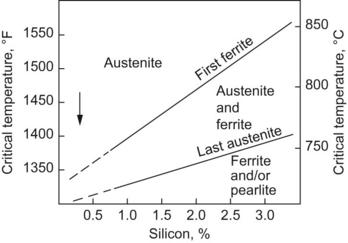
The dependence of critical temperatures on silicon content is shown in the graph, for cooling rates of 5 °C/h (9 °F/h). In this figure, the upper critical is shown as the temperature where ferrite first begins to form on cooling, and the lower critical temperature is the temperature where there is no remaining austenite.
Critical temperature values for heating at this same rate can be obtained by adding 33°C (60°F) to the critical temperatures on cooling. Note that neither the total carbon contents nor the combined carbon contents are significant.
Volume 4D, Heat Treating of Irons and Steels -> Introduction to Cast Iron Heat Treatment -> Critical Temperature Ranges