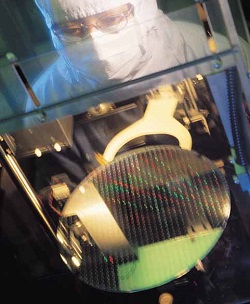
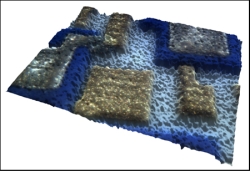
Los Alamos National Laboratory, New Mexico, announces that its scientists have developed a tungsten-based alloy that can withstand unprecedented amounts of radiation without damage. The material, created as a thin film, is a quaternary nanocrystalline tungsten-tantalum-vanadium-chromium alloy that has been characterized under extreme thermal conditions and after irradiation.
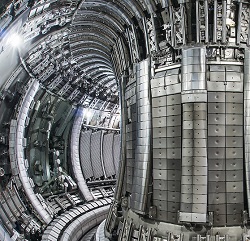
Essential for extreme irradiation environments such as the interiors of magnetic fusion reactors, previously explored materials have thus far been hobbled by weakness against fracture, but this new alloy seems to defeat that problem.
“This material showed outstanding radiation resistance when compared to pure nanocrystalline tungsten materials and other conventional alloys,” said Osman El Atwani, the lead author of the paper and the principal investigator of the “Radiation Effects and Plasma Material Interactions in Tungsten Based Materials” project at Los Alamos. “Our investigations of the material mechanical properties under different stress states and response of the material under plasma exposure are ongoing.”
“We have never seen before a material that can withstand the level of radiation damage that we have observed for this high-entropy [four or more principal elements] alloy,” says principal investigator Enrique Martinez Saez, a coauthor of the paper at Los Alamos. “It seems to retain outstanding mechanical properties after irradiation, as opposed to traditional counterparts, in which the mechanical properties degrade easily under irradiation.”