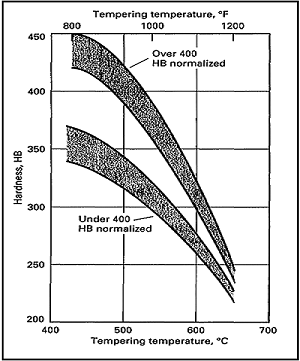
The normalizing temperature for ductile iron is usually between 870° and 940°C (1600° and 1725°F). The figure shows the effect of tempering temperature on the hardness of normalized ductile iron.
The standard time at temperature of one hour per inch of section thickness or one hour minimum usually is satisfactory. Longer times may be required for alloys containing elements that retard carbon diffusion in the austenite. For example, tin and antimony segregate to the nodules, effectively preventing the solution of carbon from the nodule sites..
Normalizing sometimes is followed by tempering to attain the desired hardness and relieve residual stresses that develop upon air cooling when various parts of a casting with different section sizes cool at different rates. Tempering after normalizing also is used to obtain high toughness and impact resistance. The effect of tempering on hardness and tensile properties depends on the composition of the iron and the hardness level obtained in normalizing.
Tempering usually consists of reheating to temperatures of 425° to 650°C (800° to 1200°F) and holding at the desired temperature for one hour per inch of cross section. These temperatures are varied within this range to meet specification limits. Figure 14 shows the effect of tempering temperature on the hardness of normalized ductile iron.
To read online, first click on https://dl.asminternational.org/books/book/9/chapter/109877/Heat-Treating-and-Properties-of-Ductile-Iron/normalizing ductile iron
Then scroll down the chapter titles in the left column, and click on Normalizing Ductile Iron