As austenitizing temperature increases, so does the matrix carbon content; the actual matrix carbon content depends in a complex way on the alloy elements present, their amounts, and their locations (segregation) within the matrix.
The most important determinant of matrix carbon content in ductile irons is the silicon content; as silicon content increases for a given austenitizing temperature, the carbon content in the matrix decreases. Austenitizing temperatures between 845 and 925°C (1550 and 1700°F) are normal. The austenitizing time is largely dependent on the section thickness of the casting and to some extent on the alloy content.
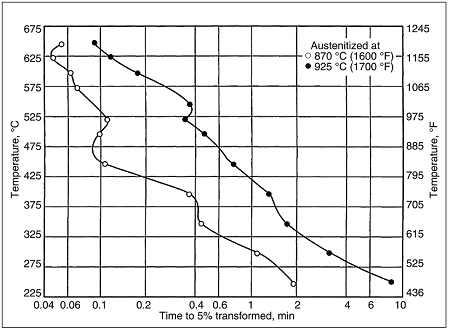
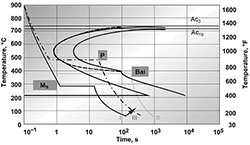
The austenitizing temperature, through its effect on matrix carbon, has a significant effect on hardenability. The higher austenitizing temperature with its higher carbon content promotes increased hardenability, which causes a slower rate of isothermal austenite transformation. This reduced rate of austenite reaction to all transformation products is shown in the beginning portions of the isothermal transformation (IT) diagrams in the graph (Fig. 18).
Adapted from: K. Hayrynen, Heat Treating and Properties of Ductile Iron, Heat Treating of Irons and Steels, Vol 4D, ASM Handbook, ASM International, 2014, p 508–521. https://doi.org/10.31399/asm.hb.v04d.a0005937
For more information on this topic, visit the article (subscription required), scroll down the Chapter Contents column on the left, and click on Austempering Ductile Iron.