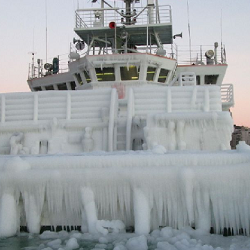
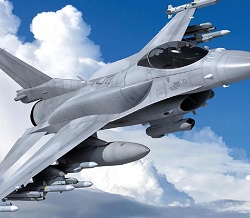
The University of Michigan, Ann Arbor, announces development of a new class of spray-on coatings based on low interfacial toughness that cause ice to easily shed from surfaces of cargo ships, airplanes, power lines, and other large structures. A paper on the research, titled “Low Interfacial Toughness Materials for Effective large-Scale De-Icing,” has been published in the journal Science.
“For decades, coating research has focused on lowering adhesion strength–the force per unit area required to tear a sheet of ice from a surface,” says Anish Tuteja, an associate professor of materials science and engineering. “The problem with this strategy is that the larger the sheet of ice, the more force is required. We found that we were bumping up against the limits of low adhesion strength, and our coatings became ineffective once the surface area got large enough.”
The researchers solved the problem by introducing a second strategy: low interfacial toughness, abbreviated LIT. Surfaces with low interfacial toughness boost crack formation between ice and the surface. Furthermore, unlike breaking an ice sheet’s surface adhesion, which requires tearing the entire sheet free, a crack breaks the surface free only along its leading edge. Once that crack starts, it can quickly spread across the entire iced surface, regardless of its size.
To test the idea, the team used a technique Prof. Tuteja honed during previous coating research. By mapping out the properties of a vast library of substances and adding interfacial toughness as well as adhesion strength to the equation, they were able to mathematically predict the properties of a coating without the need to physically test each one. This enabled them to concoct a wide variety of combinations, each with a specifically tailored balance between interfacial toughness and adhesion strength.